What's inside?
For decades, broadcast infrastructure has been built on a hardware-first paradigm: purpose-built equipment, static configurations, and capacity provisioned for worst-case peaks. That model is becoming unviable as content fragments across platforms, formats multiply, and workforces go hybrid.
A Dynamic Media Facility (DMF) treats resources such as compute, storage, network, licenses, and human expertise as flexible inputs allocated in real time according to production demand. This white paper explains how to architect and operate one, drawing on EBU and SMPTE reference architectures and implementations already running in production.
What you'll explore:
1
The case for Dynamic Media Facilities
Traditional facilities are designed for peak load and sit significantly idle. A typical facility runs at roughly 10% utilization. See how resource pooling, just-in-time provisioning, and hybrid cloud push that toward 70-80%.
Key takeaways
- Why static, hardware-centric infrastructure no longer fits
- The economics of underutilization and overprovisioning
- Resource pooling, JIT provisioning, and cost attribution
2
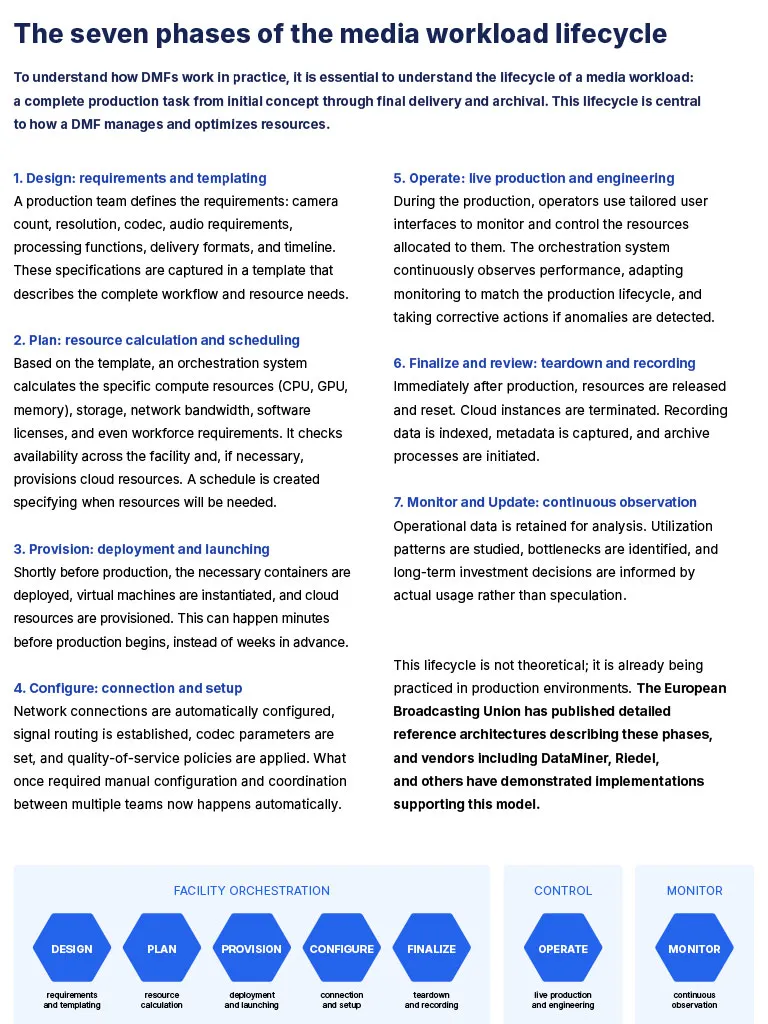
The seven phases of the media workload lifecycle
From design and planning to provisioning, configuration, live operation, teardown, and continuous monitoring, a complete production task is managed as a single, orchestrated lifecycle instead of a chain of manual handoffs.
Key takeaways
- Templating requirements into repeatable workflows
- Minutes-before provisioning instead of weeks in advance
- Automated teardown, indexing, and archival
3
Orchestration: the control plane of dynamic facilities
Orchestration means far more than IP signal switching. Understand the three dimensions (IP-level connectivity, infrastructure provisioning, and facility orchestration) and why time-, context-, and business-awareness set true facility orchestration apart.
Key takeaways
- IP, infrastructure, and facility orchestration working in concert
- Time-, context-, and business-aware decision-making
- Coupled monitoring and real-time cost attribution
4
The EBU/SMPTE reference architecture
A layered framework spanning IT and host platforms, container orchestration, the Media Exchange Layer (MXL), and media applications, letting best-of-breed vendors interoperate.
Key takeaways
- The Media Exchange Layer, Grains, and Flows explained
- Multi-vendor interoperability through standardized interfaces
- Zero-trust security across every layer
5
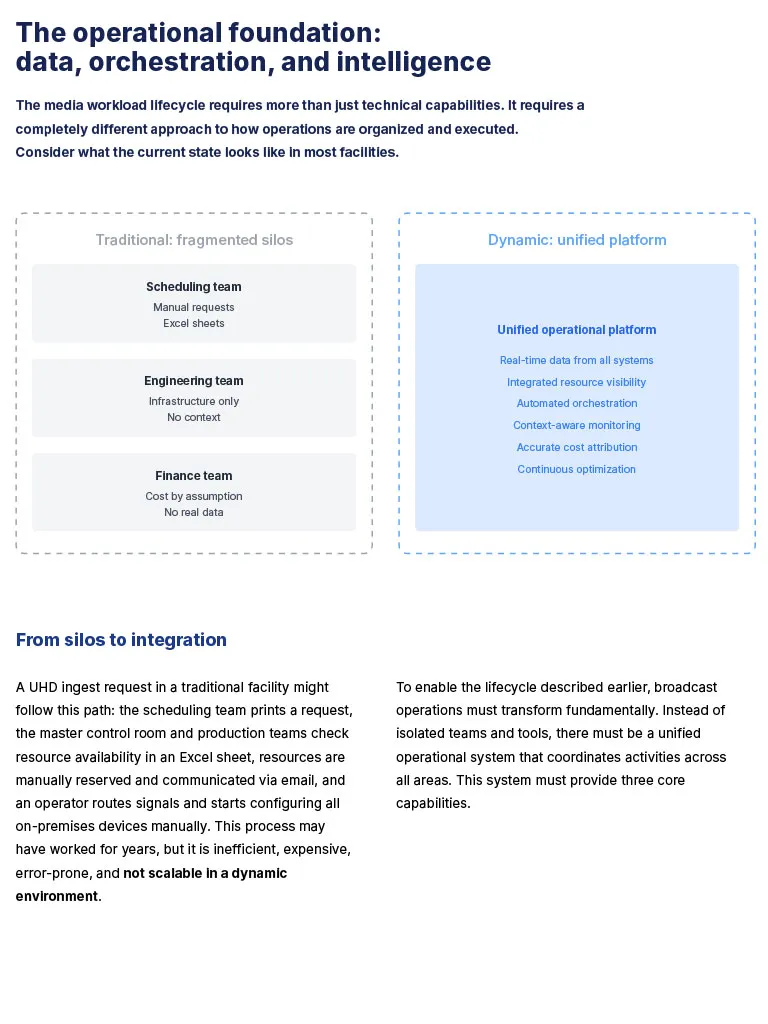
Operational discipline and the xOps platform
Realizing a DMF is as much organizational as technical. It requires unified visibility, orchestration, and data-driven decision-making, the same DNA behind DevOps, DataOps, AIOps, and FinOps, applied to broadcast operations.
Key takeaways
- Breaking down scheduling, engineering, and finance silos
- Unified data as the foundation for intelligent decisions
- Continuous optimization and predictive intelligence
6
Use cases and business value
Five practical scenarios where dynamic facilities deliver tangible returns, from geographic resource sharing and cloud burst for peak events to shipping compute to remote productions, accurate chargeback, and resilient failover.
Key takeaways
- Pooling resources across facilities and regions
- Cloud burst for predictable peaks and remote events
- Transparent cost attribution and high-availability failover
The foundational technologies are either available today or within reach: MXL specifications are maturing, container orchestration is proven, cloud is ubiquitous, and facility orchestration platforms are in production use.
The remaining work is as much operational as technical. It means breaking down silos, establishing unified visibility, and adopting orchestration incrementally, starting with specific high-value use cases and building toward comprehensive facility orchestration.